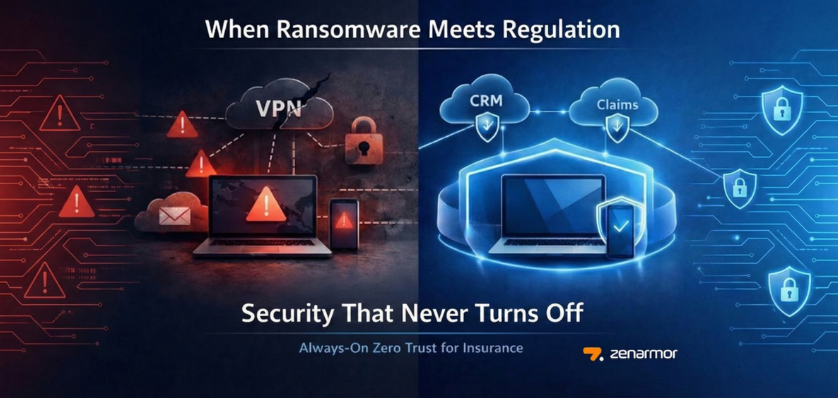
The insurance industry is one of the most attractive targets for cybercriminals. This is because insurance has three things that they look for: regulated personal data, a distributed workforce, and cloud-based networks. The insurance industry has claims adjusters in the field, underwriters who work from home, third-party insurance brokers, SaaS systems such as Guidewire and Salesforce, and many APIs who all access the same sensitive customer information. And it is this sensitive customer information which is a gold mine for attackers.
Security strategies often fail to recognize that this environment both expands the attack surface and breaks many of the assumptions that network security was built on. Because of this, insurance networks are under constant risk from ransomware, phishing campaigns, and data extraction software that knows exactly how to attack the weakest points of insurance networks.
Uncovering the Hidden Exposure Inside Modern Insurance Operations
Many insurers still rely on legacy access models such as VPNs and PoP-based SASE architectures. In theory, these approaches secure traffic by routing it through centralized cloud gateways. In practice, however, performance sensitivity, unstable mobile connections, and the growing volume of direct-to-SaaS traffic mean that not all activity consistently follows this path. As a result, some connections bypass centralized inspection altogether.
This creates security blind spots where controls are applied inconsistently or only after traffic has already moved beyond the point of enforcement. These gaps are not caused by misuse, but by architectural limitations that were not designed for today's highly distributed, mobile insurance workflows. Unfortunately, these blind spots are frequently where modern insurance breaches begin.
Attackers no longer need to penetrate a traditional network perimeter. Instead, they exploit moments when access paths fall outside centralized control, or leverage phishing and credential-based attacks against claims processors, adjusters, or partners. From there, they move laterally across SaaS platforms and cloud applications that legacy, perimeter-centric security models were never designed to continuously protect.
In some SASE architectures, this challenge is further amplified. When all traffic must traverse a single inspection point, even minor latency or connectivity fluctuations can impact user experience. Over time, this creates pressure on the architecture itself, where performance and security are placed in tension rather than working together. Any period during which traffic operates outside consistent enforcement increases exposure and compounds risk.
This growing gap between where work happens and where security is enforced has become a significant concern for regulated industries with highly distributed workforces, including insurance. As operations continue to expand across homes, branch offices, disaster sites, and partner environments, maintaining continuous, always-on security has become not just a technical requirement, but a business imperative.
How Compliance Increases Risk
Most industries only face financial loss when a breach happens. But the insurance industry also faces regulatory consequences.
GLBA and state-level NAIC model laws require insurers and other financial institutions to protect customer data through controls, monitoring, and reporting. If data theft occurs, regulators will ask if the organization was enforcing protection everywhere.
Legacy security struggles here. Policies may only be enforced sporadically. Audit trails break down the moment traffic leaves the expected path. Logs are fragmented across numerous tools. For mid-market insurance IT teams, this creates a compounding operational and compliance burden that quickly becomes unmanageable. Most teams only have a handful of people running security, compliance, and operations. Providing detailed, defensible compliance evidence becomes an impossible task.
Why VPNs No Longer Hold Up
VPNs were not designed for today's highly distributed, always-on insurance workflows. When a field adjuster connects from a disaster zone, traffic is routed through a centralized access path, which can introduce latency and create additional points of failure.
Users under time constraints may work around this by disconnecting, moving sensitive data through browsers and APIs that never pass through the encrypted tunnel, putting the information at risk.
As a result, security teams lose continuous visibility, consistent policy enforcement, and ongoing verification of user and device trust. VPNs authenticate users only at the moment of connection, not continuously throughout the session. This loss of continuous verification and inspection often occurs at exactly the moment when risk is highest. That is how phishing leads to ransomware. That is how a single stolen credential becomes a multi-million-dollar incident.
What a Modern Insurance Security Model Looks Like
To protect insurance organizations today, three things must be in place.
First, Zero Trust must be enforced at the point of access, not just the network perimeter. A claims system, underwriting portal, or network must only be reachable after the user, device, and policy all pass continuous verification, instead of simply where the user is located.
Second, threat inspection must happen at the source. Cybersecurity attacks must be stopped before they ever reach a cloud gateway or PoP.
Third, compliance controls must be uniform. Logging, access control, and data protection can't depend on whether a user remembered to connect to a VPN.
Why Architecture Matters Now
Zenarmor approaches this problem differently. Instead of relying on PoPs and tunnels, we run a single-app, single-stack SASE engine directly on the endpoint, at the edge, or in the cloud. All inspection, Zero Trust enforcement, and threat prevention happens where the traffic originates.
For insurance teams, this is a game changer.
If a field adjuster clicks a phishing link, Zenarmor inspects and blocks that traffic on their device before it even gets to the internet.
When a broker accesses Guidewire or Salesforce, Zenarmor applies ZTNA policies at the point of connection, ensuring least-privilege access without forcing traffic through a distant gateway.
When auditors visit, Zenarmor's unified stack has consistent logs and policy records across every user, device, and location that is easy to access and provide.
Why this Matters for Insurance
Insurance is under some of the most demanding forces in any industry. Agents, adjusters, and internal staff all need access to sensitive systems. Insurance must also enforce data protection, audit rules, and least-privilege access to comply with GLBA and NAIC rules.
Zenarmor's endpoint-first SASE model aligns with how insurance actually works.
- Agents can securely access claims and underwriting apps without relying on VPNs.
- Adjusters can be granted time-limited access through ZTNA.
- Salesforce and Guidewire data is protected by integrated CASB and secure web controls.
- Customer information is protected by built-in DLP and continuous inspection.
- Remote teams and disaster-response teams stay protected without the need for additional hardware.
Zenarmor's solution is delivered through one unified stack, deployed in minutes, and managed through a single console. Which is exactly what insurance IT teams need.
Where Insurance Goes Next
Ransomware and regulatory pressures are not going away. Remote work is here to stay. Cloud and SaaS adoption is accelerating.
Insurance organizations that rely on authenticate-once access models, rather than continuous verification, will find themselves unknowingly increasing their risks for data exposure.
Those that move to an always-on, Zero Trust model will be able to protect agents, data, and systems wherever work happens, without the need to trade robust security for performance.
That shift is more than just following technology trends, but ensuring survival and thriving in a world where one click can trigger a regulatory, financial, and reputational crisis.